Showing posts with label sudan. Show all posts

Friday, November 18, 2011

UN leader calls for cooler heads in Sudan

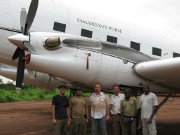
[Cover photo by Samaritan's Purse.
 Story photo by AIM-AIR.]

Sudan (MNN) ― The UN Secretary-General is trying to keep a lid on the simmering tensions threatening all-out war again in Sudan.

Ban Ki-Moon is calling on cooler heads to prevail over the conflict between Sudan and newly-independent South Sudan. The world's leaders echoed the United Nations' condemnation of  Khartoum's bombings of a refugee camp in South Sudan's Unity state--a charge Sudan's President Omar al-Bashir denies.

It's the first test of independence since South Sudan formally seceded from Sudan in July following a successful independence referendum in January that was guaranteed in a 2005 peace deal. 

Disputes that festered are flaring into violence. Phil Byler with Africa Inland Mission says, "The President of North Sudan is just a ruthless man who doesn't care who he kills. Bombing the refugee camps in the South is an atrocity, in my opinion."
It may be that the war of words is now a step closer to a genuine conflict. Satellite photos revealed last week's strikes on refugee camps were just the beginning. It appears Sudan's military is repairing and improving air bases in its Blue Nile state, potentially allowing it to bring challenge over disputed borders with South Sudan.

Now, both leaders of Khartoum and Juba are predicting the possibility of a new war in an oil-rich region that has seen a spike in cross-border attacks. "The President of South Sudan is now saying that war is a possibility. Up until this point, he has repeatedly said, 'We will not go to war again.' This is a disturbing trend," says Byler.

It is disturbing, but not alarming. "All of our missionaries, besides the pilots, are well out of the area. Samaritan's Purse personnel were on the ground; our AIM-AIR pilots were in the air, and they mobilized an intense evacuation force to deal with the bombing."  

On November 9, SIM evacuated six team members from Doro base--the area in which the refugee camp was bombed last week by Sudan's military. The team was moved before the attack. They were flown out of Doro and are in Nairobi until things settle down.  


This not only presents a direct threat to these refugees of the Nuba mountains and the Samaritan's Purse team, but a challenge for ministry and aid teams. Byler says, "The war activity along the border area disrupts life drastically. That's why there are refugees. Consequently, the work of the church and the presentation of the Gospel is disrupted as everybody goes into a survival mode."

AIM AIR has been supporting the work of relief efforts that are helping to meet the immediate needs of those who were displaced. They are providing critical supplies and evacuation options to several other organizations in contested regions between North and South Sudan. 

Please be praying for the country of Sudan as a whole, that the Church would grow strong in this turbulent time. "We're alert and watchful," says Byler, "hoping and praying that the war will not restart and/or spread throughout the region."

As the tensions ignite, "Pray that in the providence and sovereignty of God, He will spare the people of South Sudan from another war, Number One. Number Two, pray that even in the horrible things that are happening localized in Sudan, God will make Himself known to the people that are seeking Him."

Please also pray for safety for AIM AIR personnel and passengers as the team seeks to serve those who are serving in these tense locations.

Friday, August 12, 2011

Action Alert: Response to deadly drought in East Africa


(Photo courtesy Bright Hope International)


Kenya (MNN) ― Rising food prices are adding to the problem of growing hunger as the Horn of Africa grapples with its worst drought in more than half a century.

According to the United Nations, the famine has yet to peak, but  hundreds of thousands of people are likely to die without a massive global response.

More aid is getting through in critical areas, but there are many related problems. According to Bright Hope International, children are dropping out of school, and high inflation is making it extremely difficult for poor families to buy food, especially in Kenya.

Craig Dyer with Bright Hope International says responding wasn't the question. It was how best to help the sheer number of refugees on the move. "Somali refugees are placed in government and internationally-run camps. You can't work in those when you're an agency like Bright Hope. We're not given access, and so we have to look for other opportunities--surrounding areas, people in Kenya."

As a result, their response has to be carefully crafted, Dyer explains. "We've been a little handicapped in Kenya and overwhelmed, so we are in the beginning stages of it."

Rather than "reinvent the wheel," Dyer says they will do what they do best. "There are other agencies that are bigger than us, that have come in with immediate needs. So we immediately go to the next level and say, 'What can we do for longer-term needs? Water needs, agricultural issues, even jobs training and especially evangelism and church training."
750,000 refugees have already left their homes, and 9,000 more are streaming into Kenya every week from Somalia.

There are many cases of severe malnutrition, and Kenya alone says it has 2.4 million people at stressed and crisis levels. Dyer says, "The heart of it is: what is the church able to do to not only relieve the suffering of those from the famine, but also use it for the eternal purposes of our Lord and Savior, Jesus Christ?"

In Kenya, they help a ministry to Somalian refugees as well as serve thousands of the poorest people in the country. They're asking, "Where is there opportunity to say, 'This is a place where we can share the Gospel?'
Dyer says if the Ethiopia famine taught them anything, it was that meeting physical and spiritual needs change the landscape of the country. After the Christians responded to the famine over a quarter century ago, he says that many Gospel seeds were planted, resulting in evangelistic growth that grew to include 20% of the population.

The conditions are ripe for the Horn of Africa. Says Dyer, "The same thing could happen now in Somalia, where there's been such persecution of the church, now such a crisis in the country, sending people fleeing. It's our opportunity to minister to them in the name of the Lord, share the love of Christ, and hopefully have them go back to their homes and see the spread of the Gospel."

Bright Hope continues to plan out its second wave response. In the meantime, Dyer asks believers to pray that God would use the tragedy to strengthen His church. For the ministry, "Pray that the resources would come in and that the people on the ground in Kenya would be protected and find real strategic efforts that will build the kingdom of God."
There's more here.

Tuesday, July 12, 2011

Independence: The Beginning of A New Life

[Story photo courtesy Every Child
 Ministries] [Cover photo courtesy of
 Words of Hope]
Sudan (MNN) ― South Sudan marked independence Saturday with the jubilation of a people group freed from oppression. Seventy-two hours later, the big question is: Now what?

South Sudan has big expectations to fill as its birth is the culmination of a six-year peace process ending a brutal civil war. However, the new nation is wrestling with extreme poverty, inadequate infrastructure, conflict and other economic woes.

On Monday, lawmakers formed a caretaker government and announced a new currency. Lorella Rouster with Every Child Ministries (ECM) says these are all great steps forward, but there's an absence that's too glaring to ignore. "I don't see the attention of the world to help them."

South Sudan's struggles are similar to those of Northern Uganda. When Northern Uganda came to the world's consciousness, they got help. But aid groups offering to help this newest fledgling nation get on its feet have not been overloud. Despite the veneer of new, it's still a rural Third World country that lacks basic health, education, and roads, not to mention hotels, airports and internet access.
  
Rouster says this is where they can be helpful. They're an agency dedicated to showing the love of Jesus through mercy ministries to homeless street children, through seeking to release and retrain slave children, and through medical and rehabilitation ministries to the sick and handicapped.

Foresight and planning allowed ECM to be strategically placed. "I was there just a few days before Independence, training church and orphanage workers in Southern Sudan in more effective ways of children's ministry,"says Rouster.
Government reports show that those who fled North from the South are now returning home in droves. Agencies and ministries in the South are bracing for an influx of people who need their services and compassion. Rouster says, "The churches really need to reach out to the new generation that is coming up if there is to be any hope of the future. To do that, they need to make the training fun and exciting and not just sitting there listening to another sermon. So we believe that it can have a very positive impact."

Sudan ranks 154 out of 169 on the United Nation's Human Development Index. South Sudan's challenges will be converting its vast natural resources into support that keeps its people alive.

Rouster explains that while the oil is in the South, there is little else right now. "Prices are very high in Southern Sudan. Living is very hard, and rain is needed too for the crops. If the rain does not come, the prices will be way too high for the average person."

South Sudan, or "New Sudan" as it's sometimes referenced, teeters on the edge of being the next failed state if the new government can't keep social, economic and political pressures under control. As if to acknowledge the formidability of its task, the ministers of the Southern Sudanese government--with hands on Bibles--were sworn in to their caretaker role for the new Republic of South Sudan.

Rouster commented, "I think it's a question of whether they can continue to develop the integrity in their new government in such a way that God can bless their country. That's what we're praying for, and that's what Christians are praying for in Sudan: not only that there'll be peace, but  [also] that their new government will really seek the Lord."

ECM is celebrating South Sudan's "new beginning" by sharing the Gospel with the next generation. Says Rouster, "We would like people to pray that people would use the teaching that we have given them and be effective in reaching the new generation. The techniques that we've given are good for large groups, so I think that's good for the influx of new children."

"Pray that the leaders will remain strong," says Rouster. The days ahead will be taxing, but exhilarating.  As ECM's Sudan presence grows, keep praying "that they'll be up to the challenge, that they will have great vision. The churches in Southern Sudan have been growing at a tremendous rate, but that also leaves a big leadership gap, so pray that strong leaders will rise up."