Showing posts with label church. Show all posts

Friday, December 30, 2011

A building gift for Christmas

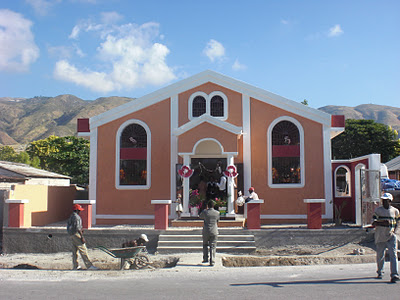
Williamson Church now standing
 after three months of rebuilding
 what Haiti's 2010 earthquake
 destroyed. (Photo courtesy of BHM)

Haiti (MNN) ― This Christmas saw much rejoicing in Haiti as members of Williamson Church had a roof over their heads to worship for the first time since last year’s earthquake.

Haiti’s earthquake in 2010 that killed over 200,000 people last year also crumbled many churches to dust. Williamson Church was among the buildings that were utterly destroyed by the catastrophe.

Members of Williamson Church put a heavy emphasis on evangelizing to other communities and planting churches. But with no building to call their own, the going has been difficult.

Now over a year later, however, a very different scene stands where there was once rubble and debris.

Three months ago, Baptist Haiti Mission (BHM) began construction of a new building for the fellowship of Williamson Church. Work was officially completed this month, and a re-dedication service was held on Sunday, December 11.

BHM Field Director, Pastor Baker, and his family along with other leaders from the Fermathe area traveled to Williamson to be a part of this re-dedication celebration.

The service started at 9 a.m. and lasted for four and a half hours. Special music groups that performed from surrounding churches and a message of thanksgiving was presented by Pastor Edrice Romelus of Thomassin Conservative Baptist Church.

Toward the middle of the service, a plaque of appreciation was presented to Pastor Baker and BHM. Pastor Jean Claude Smith of the Williamson Conservative Baptist Church acknowledged the many needs of the people of Haiti.

Smith was quick to state that he was incredibly thankful that God had chosen to bless his church family through the gifts of the supporters of BHM for a new building. Spirits were high, and the name of God was praised.

There have been a variety of pressing needs since the time of the earthquake, and BHM has been working diligently to meet these needs. They responded immediately to Haiti’s 2010 earthquake disaster with aid supplies such as food, water, shelter, and hygienic and medical items.


Wednesday, November 30, 2011

If people don't come to the church for help, OM Greece comes to them

Greece (MNN) ― The debt crisis in Greece has thrust the nation into economic turmoil, but the outcome of the situation has reached much further than bank accounts.

The emotional effects of the crisis continue to scar.

Operation Mobilization country leader for Greece, Kees den Toom, says, "Generally speaking, there is great unrest and fear for the future. Much heated discussion is placed on the current political and economic situation. Pessimism and even fatalism are emerging."

It's a bad sign in a nation that will have little to do with anything but the ritualistic side of the church. 98% of the nation is Greek Orthodox, but Toom says the church hardly relates to everyday life for Greeks. The institutions of baptism, marriage, and burial are believed to be the means to attain salvation.

Toom says despite the Orthodox presence, abortion rates are extremely high: for each baby born, two are aborted. Also, one in four men visit brothels. Toom adds that materialism has also become the god of many, and with the economy falling, it's hard to know where to turn.

The hope is that they would turn to the church and ultimately to Christ. However, this is rare, says Toom. The Evangelical community is very small, making up 0.2 % of the population. According to Toom, the church in general is very fragmented and divided, and it was inward focused for many years.

Although some churches are starting to respond to the needs of the community, when religion is viewed as nothing more than tradition, people don't often look to the church for solutions.

If people will not come to the church, then, OM is bringing the church to them.

OM Greece seeks to respond to the current crisis by sharing the message of hope through Christ while meeting the basic needs of the most needy: the homeless, gypsies, and immigrants. OM tries to address these issues in the local church whenever possible.

With the breakdown of social services, Toom says OM sees challenges and opportunities in areas such as the need for a place of refuge for battered women and their children, as well as feeding programs.

"We know that only Christ can bring restoration and healing to this country, and we need to share the message and Biblical ethics to a society that neglected the church's direction and authority a long time ago," says Toom.

OM Greece is working hard to spread hope in the midst of chaos.To learn more about their work and ways you can help, click here. 

Monday, November 28, 2011

Bible truths fight creeping communism

SGA team in Russa (Photo courtesy
 of Ken Ham)

Russia (MNN) ― With trends such as a high rate of foreign immigrants, new leadership and policies, and sliding back to a communist mindset, it’s little wonder that Russia is putting greater pressure on the church.

Eric Mock with Slavic Gospel Association (SGA) says Russia is in the process of establishing its identity. This includes the new leadership putting an emphasis on going back to Russia’s roots—roots that communism had sprouted from in the past.

“I think their leadership tends to be more controlling, and as such, it’s kind of a top-down approach, so the social system works off of that,” states Mock. “But I think the major transition that we’re seeing is that the ground for the Gospel is so much harder.”

Mock goes on to point out, “A very small percentage of those who claim a Christian faith would hold to salvation by grace through faith and a literal heaven and hell. You’re finding that those who are what I would call a Bible-teaching church are actually a very limited number of churches to reach Russia.”

With such a crisis setting in for the Russian church, SGA is stepping up their game to initiate conversation about Biblical truths and train up Russian leaders who will establish Biblical foundations for the church.

To do this, SGA recently partnered with Ken Ham’s "Answers in Genesis" to produce his "Foundations" series translated into Russian. This series presents Ken Ham’s major talks about Biblical truths with a heavy emphasis on Genesis. It also comes with a curriculum kit that can be used as a study guide by churches and small groups.

Mock explains, “We would like to help the local church be able to communicate a Biblical worldview where we understand that Scripture is completely adequate for all aspects of life, that it’s true from cover to cover, and that, in this case, science and religion don’t need to be two separate things. In fact, the Bible is the lens by which we view the world around us.”

Please pray for people of Russia to understand that their hope does not rest in the government, but ultimately in the Lord.

Pray that more Russian church leaders would become grounded in Biblical truths and train up others to go out and spread the Gospel to every corner of their country.

Thursday, September 22, 2011

Typhoon Roke swipes at Japan's sore spot

Mission Network News:


Japan (MNN) ― Typhoon Roke took a swipe at the disaster zone in Japan.
It also brought evacuations, flooding and more worry to the country struggling to recuperate from the tsunami, quake and nuclear disaster in March.

Friday, September 16, 2011

Christmas right around the corner; 50,000 gift boxes readied


Russia (MNN) ― While autumn doesn't officially begin until next week, at least one ministry is already preparing to reach thousands of young people during Christmas. The effort is called Project Hope and is an outreach of Russian Ministries which serves in the former Soviet Union.

Speaking from Moscow, Paul Tokarchouk with Russian Ministries says national churches in Russia, Ukraine, and Moldova are preparing as we speak. "More than 300 different evangelical churches are putting together all their meetings and all their activities so that more than 50,000 kids would hear the Gospel during the Christmas season."

While Christmas is more than three months away, funding is needed to help the national churches purchase the gift boxes that will have toys, clothing, personal care items, and God's Word, says Tokarchouk. "[We're] not only providing the gift, but the story about Jesus Christ who can bring the hope for the young hearts."

The program is targeting orphans, street kids, and the desperately poor. Tokarchouk says, "Christmas time is a relevant and significant time where they can share Jesus' story so they could have the hope for their future."

As you provide funding for this project, you're doing more than just providing a gift for a child. As adults bring these children to the activities, they too hear the Gospel message. According to Tokarchouk, as they see the good deeds and hear an inspiring message, many begin attending the local church where they have many more opportunities to hear about Christ.

Tokarchouk says Project Hope is a time for training. "This is one of the opportunities for the young generation, as they're going through training during the Fall and putting [what they're learning] into practice."

If your church or Sunday school class is looking for a Christmas ministry project, this is a good one to consider. Just $25 provides a Project Hope gift for Russian churches to distribute at Christmas time. Set a goal. Keep track each Sunday. Pray for the ministry. Then perhaps join Russian Ministries on a Project Hope distribution trip.

For information, click here. 

Thursday, September 1, 2011

August 13 - A Day of Multiple Commemorations

Do “Iron Curtains” happen more than once?

By William Yoder
Special to ASSIST News Service


MOSCOW, RUSSIA (ANS) -- Two separations significant for World Christendom commemorated their 50th birthdays on August 13, 2011: the construction of the Berlin Wall and the splitting up of the “All-Union Council of Evangelical Christians-Baptists”.

On August 18, 2011, in one of two major Russian-language commentaries on the second event, Moscow’s Mikhail Cherenkov celebrated in the news service “Protestant” the maverick and courageous spirit of the underground, “Initiativniki” Baptist movement. He described them as a “mighty spiritual” and “radical reformist” movement and exclaimed: No one could have expected that an “anti-church directive” put out by the All-Union Council could “invoke such massive resistance on the local-church level”.

Who would have reckoned that “simple, uneducated, inexperienced pastors from the most remote of provinces could organize a resistance movement capable of engulfing the entire Soviet Union?” Cherenkov compares its martyrs to the early church fathers who died with “For Christ alone!” on their lips. The Initiativniki were in any case also part of the “down with Moscow” sentiment still alive in the wide expanses of Russia.

But it must be remembered that the Initiativniki movement also fought other Baptists. Andreas Patz reported in Germany’s Russian-language “International Christian Newspaper” on 11 August that the Initiativniki front began to unravel only two years after its founding. Initiativniki non-cooperation at an all-Union “synod” in 1963 and ugly scenes in congregations thereafter prompted many to leave its ranks.
An autonomous Baptist movement apart from both the Baptist Union and the Initiativniki – Patz calls it an “opposition to the opposition” - appeared. Today, the Protestant scene in not a few Russian towns - Stary Oskol and Dedovsk (near Moscow) for ex. - consists primarily of such autonomous Baptist groupings.

A blogger noted that despite Gennady Kryuchkov’s warnings, lower-level “fraternization” between registered and non-registered Baptists never ceased, especially in the realm of underground “Samizdat” printing. Kryuchkov (1926-2007) headed the Initiativniki in Russia proper from 1965 until his death 42 years later. His “underground church” was initially known as the “Council of Churches of Evangelical Christians-Baptists”. After massive emigration, it was renamed the “International Union of Churches of Evangelical Christians-Baptists” (IUCECB). It recently reported a global membership of 78.015 – roughly 20.000 of them still residing on Russian soil. During its heyday (1966), the movement claimed as many as 155.000 members.
Patz’ commentary describes well the pain and price of division. He reports that after 1961, roughly 1.500 Baptists (these would include registered and unregistered Pentecostals and Mennonites) were sentenced to a total of 5.000 years in prison. This works out to an average sentence of 3,33 years; thirty of these persons also died in jail.

The Initiativniki are an impressive testimony to the stalwartness of the human spirit in the face of incredible odds. But wars, including religious ones, also cause collateral damage – among children, for ex. The patriarch Kryuchkov lived underground on the run from Soviet authorities from 1970 to 1990. Even IUECB-circles admit today that none of his nine children are in the Christian fold.

Alexander Prokhanov, perhaps Russia’s most prominent nationalist, far-right writer, is chief editor of the ultra-nationalist “Zavtra” magazine. “Wikipedia” reports that he and a colleague invited the US-Nazi Donald Duke to Russia in 1999. Alexander is the grandson of Ivan Prokhanov, a leading father of Russia’s Baptist and Evangelical-Christian communities. But Alexander’s convictions cannot be blamed on Ivan, for Grandpa died in 1935, three years prior to the grandson’s birth. But this aside is one indication of the fact that “once-Baptist-always-Baptist” does not reflect Soviet and Russian reality. More than a few of today’s Russian intellectuals and politicians have one-time Baptist connections.

Patz reports that the Great Division of 1961 turned long-time friends and relatives into “irreconcilable enemies”. Married couples suddenly found themselves on opposite sides of the fence, their children confused as to with whom they should attend church. “At home, children were subjected to the constant quarrelling of their parents. Disappointed, they went out into the world once they were grown. And how many of these families were driven into divorce and destruction?”

The current situation


Today, the IUECB’s adherents, the majority of whom now live in Germany and America’s Pacific Northwest, appear to reflect a movement frozen in time. The demise of the aggressive, Soviet adversary has condemned them to insignificance in the public arena. Yet much like their cousins, the Russian Orthodox Old Believers, who broke with the majority church in 1666, they insist on an aged agenda of minimal interest to today’s secular societies. Yet biology will keep the movement going as long as at least of few of its many offspring continue to uphold the faith. Much like the North American Amish of Mennonite tradition, they will be of interest primarily to ethnologists and curiosity-seeking tourists. Few outsiders will consider them worthy of emulation. Non-Russian, North American missions present in Russia during the past two decades dismissed them entirely.

Resistance to authority is at the core of their belief. To accept a conciliatory position would destroy their reason to exist as a separate entity. Patz reports that the IUECB’s “Historical-Analytical Department”, now run by those too young to ever “have sat” or “been betrayed”, has retained the methods, accusations - and mistakes - of the past. Consequently, the gulf of the past half-century is on the increase.

Patz cites a speech by Gennady Kryuchkov at the IUECB’s major Tula gathering of October 5-6, 2005, in which he described the registered Baptists (today’s “Russian Union of Evangelical Christians-Baptists” – RUECB) as the “broad way”, and the way of his movement as the narrow one. He added: “And these two parallel paths will never cross even in eternity.” Kryuchkov was apparently claiming there would be only one kind of Russian Baptist in paradise – not, that the division of 1961 would extend into heaven.

Cherenkov, though heaping the Initiativniki with praise at the outset of his article, admits later that the movement has lost its positive passion. It has now turned to “solidifying its structures of control and its nearly canonical traditions with its own gallery of heroic fathers and an iconostasis of martyrs”. It has surrounded all of this with “a protective iron curtain”. The “absence of inter-church dialogue” has kept the movement from updating its convictions to confront the dangers of the present; the course of the Initiativniki has consequently ended in a dead-end street. “It’s an irony of history that a reforming impulse very rarely springs from the same source twice.”

Mikhail Cherenkov portrays the IUECB as a progressive movement turned reactionary. I would prefer to describe the Initiativniki of 1961 as a “conservative resurgence” akin to the movement within America’s “Southern Baptist Convention” two decades later. The Initiativniki did not uphold progressive values, but were instead intent on restoring the past. It could be argued that they did not even uphold the banner of religious freedom when it involved those not of their own particular brand of faith.

The tragedy


Even the best of intentions can lead to the saddest of outcomes – the Initiativniki movement could therefore be described as a tragic one. They believed in their love of Christ and his Word – yet their actions have been interpreted as evidence of hatred by others. One’s desire for purity and steadfastness can be understood as contempt of other positions. The Initiativniki’s witness hit a low point when a Ukrainian couple in Salem, Oregon/USA was imprisoned in late 2009 for physical abuse of its children. The IUECB chose to decry the sentence as religious persecution.
It is important to understand why Germany’s émigré-German-Russian church community is strewn across the landscape. “Idea” magazine’s Helmut Matthies has described each tiny grouping of congregations as beholden only to itself. Cooperation on a larger scale appears impossible. The Initiativniki have proven strong on remaining true to their convictions; they are much less skilled in living alongside those who think differently. They sin differently than we Westerners do, for they have been shaped by a very different past.

The Cold-War West tended to portray the Initiativniki as spiritual giants – at least until they emigrated westward. Yet they have proven to be mere mortals; it is a myth that repression automatically makes believers more angelic. Perhaps it is pride combined with fear that has forced their witness to self-destruct. In Norway a century ago, an Arctic balloonist and explorer was determined not to renege on any of his boasts. He chose instead to float northward toward a certain and frigid death. On occasion, groups are not humble enough to save their own skins. Tragically, pride may have cost the Initiativniki the fruits of their courage and suffering: “Pride cometh before the fall” (Proverbs 16, 18).

Walls and divisions are a product of human sin; only a spirit of forgiveness could turn things around. A church division caused by state repression and internal sin smashed Humpty Dumpty’s egg. Only forgiveness could restore that egg. Limiting sin to others, to other specific groups, places and times, is always a dead-end. The Initiativniki too are mere humans.


Dr. William Yoder is a US-born American from Germany who lives in Belarus and works in Moscow, Russia. He grew up in the Mennonite church in Sarasota, Florida, but has spent most of his time since 1971 in Germany, largely in Berlin. He graduated from Eastern Mennonite College in 1973 and received a Ph.D. in political science from the Free University of Berlin (West) in 1991. His dissertation was on the role of the Evangelical Church in East Germany between 1945 and 1961. After a stint with the Lutherans in Russia’s Kaliningrad/Königsberg enclave, Yoder has been active since late 2006 as media spokesperson for the Russian Union of Evangelical Christians-Baptists and the Russian Evangelical Alliance in Moscow. One of his primary activities involves the composition of press releases in English and German. He is married to Galina, who hails from Barnaul in Siberia. He can be contacted by e-mail at: kant50@web.de

Tuesday, August 30, 2011

Malaysia Church Raid Stokes Religious Tensions

A raid by state Islamic enforcers on a church function in predominantly Muslim Malaysia has stirred religious tensions and revived fears of growing Islamisation. During a dinner at a Methodist church hall outside the Kuala Lumpur on August 3, officers arrived saying they had information that a group of Muslims were being converted, which is prohibited. The incident, though described as tame, has nevertheless unnerved some. The Damansara Utama Methodist Church denied the event was held to convert Muslims, but Islamic officials and pro-government media pounced on the case to allege a widespread Christian proselytising campaign. Malaysia likes to portray itself as a modern, ethnically harmonious Muslim state. "I am very unhappy with the way Christians are being portrayed and why authorities are treating the community so suspiciously," Maria Varghese, 37, a Kuala Lumpur schoolteacher and ethnic Indian Christian, told AFP. "We are not trying to convert anyone. We have friends of all races and religions and have lived happily for centuries. I don't understand why they are attacking us."

Leadership training a perceived threat in Zimbabwe


Zimbabwe (MNN) ― Zimbabwe has been struggling for over a decade. Under current president Robert Mugabe's rule, the people have struggled with recession. That has led to an out-of-control economic collapse, 80% unemployment, and more.
However, Christian World Outreach is making a difference by providing leadership training, which is craved by many. "They're eager to hear and to learn. There's a great demand for the seminars. But what's probably held us back is the financial means to hold more seminars," says CWO's Greg Yoder.

Yoder says, "Since 2001, we've been holding leadership training with pastors from the churches and lay leaders. Since then, we've had 4,000 pastors from 50 different churches go through the training."

The training happens monthly, and not without opposition. "Any time groups meet, there's always suspicion. We get 40-50 pastors together, and there can rise the suspicion of something going on -- anti-government meetings, or something like that. There is the political unrest. We've had to postpone or cancel leadership seminars because they can't gather together in groups."

The reality is: this training could change a nation, says Yoder. "As they do the leadership development, Christian men and women will rise and be a part of the solution for Zimbabwe, and they'll be involved in their communities--even in their local government."

There's another reason for biblical training: "Islam is making inroads there. So the stronger we can help the church become, the better for advancement of the Gospel."

While funding is a desperate need, Yoder is asking people to pray for safety. "Pray that we'll be able to hold the seminar and that God will provide the needed funds."

Monday, August 22, 2011

Crisis can't shred church bonds


Ethiopia (MNN) ― The famine may be crippling. The Muslim voice may be strong. Fleeing refugees may crowd the borders. But the evangelistic churches in Ethiopia are linked in unity and strength like never before.

Global Advance witnessed this incredible unity at their Frontline Shepherds Conference conducted in Ethiopia's capital, Addis Ababa, last month.

With the Frontline Shepherds Conference, pastors were even more equipped with a sense of unity as they were trained in church growth, planting and missions. Pastors were also challenged in their personal walk with the Lord, and many committed to plant a new church within the next 12 months.

David Shibley with Global Advance says, "It's one of the few places in the world where all evangelical churches--almost 100 percent--are cooperating with one another, encouraging one another."

The background of Marxist persecution and ongoing trials today have only strengthened the Ethiopian church. "There was a unity that was forged during those years of Marxism where many of the pastors suffered, many of them were imprisoned, and many of them were tortured for their faith in Christ," states Shibley.

The Ethiopian church is expanding. Since the fall of Marxism in 1974, the number of evangelicals has grown from 5% to nearly 20% today. Congregations spread, and more and more pastors have a passion for bringing the Gospel to others. Training and resources are in high demand.

"In developing nations like Ethiopia, this may be the only pastoral training that these men ever receive," says Shibley. "It was wonderful, during the breaks, to see these pastors sitting at their place and not going to take tea, but rather reading through these manuals, because for many of them, it's one of the very few--and perhaps the only--book they possess beyond the Bible itself for any kind of ministry training."

Frontline Shepherds Conference only added to the unity by connecting pastors across denominational lines. In this bonded strength among the church, pastors were more enabled by the training conference to reach out to their suffering communities in the famine disaster.

"The church in Ethiopia is responding with the resources they have," ensures Shibley. "In the midst of this, the Gospel is going forward. In those [refugee] camps, people are coming to Christ, and God is using this terrible disaster to bring people to faith in Him."

Please pray for continued healing and life, both physically and spiritually, as the church works to encourage a starving and conflict-torn Ethiopia. Pray that the Gospel would be proclaimed through all things and that the pastors would spread the light of Christ in the wake of the conference.

Tuesday, August 16, 2011

Washington State: Church Can Picnic in Public Park, but not Baptize


According to The Seattle Times, the state Department of General Administration has refused to give a permit to an Olympia church that wants to hold a baptism along with its barbecue and picnic Sunday at Heritage Park on the Capitol Campus. The state constitution does not allow for state resources to be used for the exercise of religion, ruled Jane Rushford, acting director of the department. "We are approving their use of Heritage Park for the purpose of a picnic, a barbecue. We are denying their permit for the purpose of holding a baptism," said agency spokesman Jim Erskine. The church held picnics two previous years in Heritage Park without incident, and its permit this year lets it move forward with another picnic-barbecue at noon Sunday. It was not clear whether a legal challenge will ensue."

Monday, August 15, 2011

Palau festival marks historic unity for Burundian church

Burundi (MNN) ― In what church leaders are calling a "historic step toward unity," 500 Burundian churches gathered early last week and the previous week to worship the Lord.

Although the civil war that wrecked the nation for over a decade ended in 2005, divisions throughout the nation remain thick. Disunity between the Hutu and the Tutsi ethnic populations in particular created historic conflict resulting in endless turmoil. Reconciliation is far away for many.

And yet, churches from all different divisions of the country came together for the Love Burundi Festival hosted by evangelist Andrew Palau, son of Luis Palau. Local church leaders noted the unity as a significant change.

"We know that the hope of the country is based on unity," pastor Jeremie Ndayishimiye told the Luis Palau Association. "So we really thank God to see how many people, how many leaders, [were] willing to come together for this festival."

And many came. The outreach culminated in the two-day Love Burundi Festival on August 6 and 7. An estimated 60,000 people crowded the capital city's COTEBU grounds during the weekend. Decision cards are still being counted, but early numbers indicate that 8,000 people made public decisions to accept Jesus Christ during the festival.

Each individual received a copy of the Gospel of John and discipleship materials at the festival. They will all be given follow-up guidance from local churches as well.

The event began with a week of community outreach and service. In the days leading up to the festival, ministry teams from the U.S. and volunteers from Burundi's churches facilitated a "Season of Service" throughout the city, volunteering at a much-needed eyeglasses clinic, gatherings for women, and a school for deaf and hearing-impaired children. Coaches from Play for Hope, a Rwanda-based youth program, hosted basketball and soccer clinics at 17 different locations throughout the week.

Palau and musical guest Dave Lubben also took the festival to more than 2,000 inmates at Bujumbura's Mempimbo prison earlier in the week. Hundreds of inmates accepted Jesus Christ as their Savior after hearing Palau share a message of reconciliation and freedom in Christ from John 8.

Tens of thousands of people heard the Gospel throughout the week, from children, to prisoners, to hurting individuals. The weekend festival even received coverage from all national media. Many noted how the Lord was clearly moving in Burundi. Pray that this festival will have planted the seeds of life in many hearts, and that this may be the inspiration for change that the church in impoverished Burundi needs.

The Palau Association reaches hundreds of thousands with the Gospel each year. To learn more about their ministry, visitpalau.org.palau.org.

Wednesday, August 10, 2011

Church is the body, not the building


Grace Bible Church of Uruguay celebrates 29 wonderful years of ministry. Their theme: Unity in the Body of Christ. (Photo courtesy of Addison Berry)


Uruguay (MNN) ― Twenty-nine years of ministry was celebrated recently by Grace Bible Church of Uruguay.

The church has been working closely with Grace Ministries International since their inception in 1982. Their mission is to minister the name of Christ to the people of Uruguay, both encouraging believers and reaching lost souls for His name.
In celebrating their 29th anniversary, Grace Bible Church of Uruguay focused on unity in the Body of Christ. The passage used to illustrate this theme was 1 Corinthians 12:14-27.

Verses 25-27 of that passage read, "There should be no division in the body, but that its parts should have equal concern for each other. If one part suffers, every part suffers with it; one part is honored, every part rejoices with it. Now you are the body of Christ, and each one of you is a part of it." (NIV)

Following God's command to share in the joy and pain of others, the congregation of Grace Bible Church of Uruguay collected food for the needy and spent time in prayer during their anniversary celebration.

As people gave gifts specifically for the church, they witnessed their gifts encouraging and uplifting other members within their church body. Such a joyful celebration of unity in Christ was refreshing, especially considering the spiritual climate of the country.

Uruguay has undergone severe separation of church and state since laws were enacted for this purpose in 1918. Roman Catholics and atheists dominate the religious scene of the country, with evangelicals claiming just over six percent of the population.

Grace Ministries International currently has two missionaries working with Grace Bible Church of Uruguay. Ricki Anne Zanella, a graduate of Grace Bible College in Michigan, works with the women's and children's programs in the church. A newert GMI missionary, Aimee Johnson, also works alongside Zanella in her efforts.

Please pray for this church to experience continued growth and strength. In following God's command to pray for members of the body, please also pray for a woman in the congregation who has received troubling news from doctors following a recent surgery.

Sunday, August 7, 2011

Lindsay Jayne: Talking Music, Life, and Thor in the Land of Enchantment

By Brian Nixon
Special to ASSIST News Service


ALBUQUERQUE, NEW MEXICO (ANS) -- When Producer Joey Belville called to ask me to play cello on a song by the group LindsayJayne, I asked, "Who?" Joey replied, "Dude, just wait. These ladies are the real deal!"

LindsayJayne: Jayne on left, Lindsay on right.
So as is my custom, I showed up at the studio with the cello on my back, open to any new concoction Joey may be brewing. I tuned my cello with tea at my side, listening to Joey prep the song. As the song begins to unfold, I say aloud, "I like this." And quizzically, "Now who are these ladies again?" Joey smiled and said, "I told you so." And with a producer's swagger, continued, "I'll set up a meeting."
I went to meet Lindsay and Jayne at Solomon's Porch in Albuquerque, New Mexico. Quite frankly, it was a perfect day for an interview. We had our first morning of rain in over sixty days. So the atmosphere and smell of fresh rain made it an inviting time to sit down and talk.

I looked around the café. Out of the corner of my eye I saw a young lady and so I approached. "Are you one of the gals I'm to interview?" I asked. "I am! Are you Brian?" "And your sister?" I continued. "At the bookstore." If they like books, then I like them already.

We sat down on a couch off to the side of the café and began our conversation.

"Tell me about yourself?" I asked. "Who is LindsayJayne?" "Well, we're sisters who write, perform, and play music," Lindsay replied."

"And have you been playing music together for long?" I then asked. Jayne jumped in: "We've been playing music our whole lives. We have a fairly musical family. Our parents, aunts, uncles, and cousins all play music.

It's sort of in our DNA." Lindsay nodded. "As a matter of fact, when our mom was pregnant with each of us, she would put headphones on her belly and play music to us," Jayne continued.

The sisters laughed at the idea, remembering a family moment that obviously resonated with both. Looking at
Lindsay, I asked, "What instrument do you play?" "Guitar." And you, Jayne?" "Piano."
Ok, ok, I mused. Nice answers. But give me the story: "How did all of this all happen?"

"Well it began over six years ago," Lindsay said. "I moved to Bend, Oregon where I did a two-year discipleship program at a church called Westside. There I met my husband, Eric. It was around this time I started to pursue my music. "After about five years in Oregon, Eric and I decided to move back to New Mexico for me to pursue my musical passions and for Eric to pursue a career in film. As you know, the movie industry has a large presence here in New Mexico, so Eric felt this would be a good fit."

Jayne jumped in to expand the horizon: "We each were developing our musical pursuits around the same time: me in Albuquerque and Lindsay in Oregon. So when she moved back we both had our own individual musical interests, but didn't think about combining them."

"So how did you begin?" I went on to ask. "It began one afternoon when Jayne was playing piano," Lindsay said. "I 
went to get my guitar. We started playing together and realized that 'this could really work.'""Initially," Jayne interjected, "we were writing for fun, just sisters reconnecting. But then we realized that the songs we were writing were pretty good. So we decided to take this a little more seriously."

Producer, Joey Belville

"And how did that happen?" I prodded. "I was already recording with Joey Belville on a side project he produces called Pristina," Jayne replied. "So I went back to Joey and said, 'I feel I would be much better with my sister in the mix. I think we complement each other very well. Joey was intrigued and asked if he could hear us."

"Around this time a band called Elliott was on tour from Oregon," Lindsay said, taking over. "And knowing me from Oregon, the band asked if we would be interested in opening for them. We said yes. "We played an art gallery called Revlis, and invited Joey to attend so he could hear Lindsay and I play together."

Around this time in our interview, Joey Belville strolled into Solomon's Porch with a backpack and workout clothes in tow. After a brief chiding for his workout shorts, we invited Joey into the conversation.

"I remember the concert really well. The ladies did an amazing cover of the U2 song 'Sweetest Thing'" Joey stated. "Bono would be proud."
"We did four original songs that night," Lindsay said. "Plus the U2 cover." "I think 'Sweetest Thing' came out real cool," continued Jayne. "We added a minor chord twist that took it in a new direction."

"Yeah. I really felt they had a great chemistry," Joey clarified. "The way two sisters can intertwine their vocals into one is quite wonderful. Also, the songs were great."

"Tell me about a couple of the songs you've recorded," I said. "The first song is called 'No More Pretend,'" Joey stated. "It's a waltz in ¾ time."

"What sort of instruments do you use in it?" "It's pretty simple," Jayne replied. "We had guitar, piano, glockenspiel, and crickets." "Crickets?" I asked. "We recorded outside at night and caught the sound of crickets," Jayne replied. "It was pretty cool."

"And what is the song about?" I asked. "The lyrics were co-written," Lindsay said. "But basically it's about life after someone leaves -- sort of a song of absence and longing for that person."

"How long did it take to record?" Joey gives his answer: "It took a little longer than normal. I was figuring out the style, musical intricacies, and such. So, in all, over two months."

"And the second song, 'My Apologies,'" I tossed out. "What is that song about?"

Cover for My Apologies
"The song is about fighting," Jayne replies. "Fighting?" I asked. "Are you boxers on the side?" "No, no," Jayne said, smiling. "It's about coming to terms with being wrong and admitting it."
"Essentially," Lindsay clarified, half joking, "It's about me and how I can be stubborn when I fight. It's basically me apologizing for myself."
We all laugh.

"And the instruments in this song?" I continued. "Overall, this is a more upbeat song," Jayne stated. "We have electric guitar, synthesizers, cello, drums, bass, and acoustic guitar."

Joey nudges in. "This song is different from 'No More Pretend,' sonically speaking. It's quite a bit more upbeat. All of the LindsayJayne songs are really vocal-centric, though. There are layers and layers of vocals-a lot of 'oohs' and 'ahhs.' The vocals really help build the song. In a way, it's a journey of vocals: very lush and atmospheric."

"We're excited about this track," Jayne stated. "It's dreamy and lush, yet still intimate like 'No More Pretend.'"

"What have been some of your musical influences?" I asked. "We have many," Lindsay said, thoughtfully. "To start, Alison Krauss. We grew up with her music. But beyond that, we enjoy The Civil Wars, Brooke Frasier, Feist, Jon Foreman, and Copeland." "But we pull from a variety of influences," Jayne stepped in. "We like a unique sound with eclectic instrumentation."

"Do you have a name for the EP?" I asked. "Yes. As of now, it's called Seven Seas," Jayne stated.

"Do you have a release date?" "Not yet. We're still working with Joey in the studio. But people can get the first song off of iTunes under the On Mono label," Lindsay responds.

"Dude," Joey screamed, clapping his hands. "You have got to put this in the article! Lindsay was Natalie Portman's stand-in for the movie Thor. How cool is that?"

"Really?" I asked Lindsay. "Yeah. It was really fun working on the set. I met a lot of great people and got to see what happens within the background of a major movie."

"So what's next for the group?" I asked, concluding our time together. "Our goal is to finish the EP, perform more, and see what happens next," Jayne replies.

I'm sure there will be a lot of "what happens next" for this talented sister duo. If my hour with them is any indicator of the quality of person and talent potential, then the sky is the limit.

And speaking of the sky: As we say our goodbyes, a light rain is falling, refreshing all that it comes into contact with. Maybe just like LindsayJayne.

To learn more about LindsayJayne, check out their Facebook page at http://www.facebook.com/pages/Lindsay-Jayne/125060870873302?v=info or hear their newest single, My Apologies, http://amzn.com/B005G0E3OS

Brian Nixon is a writer, musician, minister, and family man. You may contact him at www.briannixon.com


Friday, August 5, 2011

Tropical storm a concern in Haiti

A Compassion project in Haiti.
Haiti (MNN) ― Weather forecasters predicted as much as 20 inches of rain to hit Haiti yesterday, but it's uncertain what Tropical Storm Emily will leave in her wake. As the storm lumbered across the nation, the more than 600,000 Haitians living in tents and make-shift homes feared the worst.

Compassion International serves more than 66,000 children in Haiti. Compassion spokeswoman Kathy Redmond says, "People living in tents, living in that close proximity with still very little sanitation -- that gets a little concerning."

While there are damage reports, exact figures aren't available yet. One thing is certain, says Redmond: "A lot of these people in the community, whether they're Compassion beneficiaries or not, go to the church for their supplies."

Compassion works through the local church because it helps them be valued in their community. "These churches are transforming whole communities. Where you would have lawlessness and that sort of thing, these churches make a difference. They are giving the Gospel, and you know, there is a battle going on in Haiti--a very spiritual battle."
Since the devastating earthquake struck Haiti over a year ago, churches continue to grow.

Child sponsors are needed to help fund the ministry of Compassion in Haiti. If you can't do a monthly commitment, you can still help through another program," says Redmond. "It's called Compassion's 'Water of Life' program. And for $55, you can buy awater filtration system that can go into a child's house and supply the entire with clean water for their lifetime."

Clean water is vital to their program worldwide. Redmond asks, "How many of the diseases that are responsible for the deaths of children -- well, it's all about clean water. So, for $55 you can make sure these kids have clean water and it's in their house."

If you'd like to get involved in Compassion's work, click here.


A Shining Star in The Birthplace of Jesus

My peaceful return to Bethlehem Bible College to meet its founder, Dr. Bishara Awad

By Dan Wooding
Founder of ASSIST Ministries


BETHLEHEM, WEST BANK (ANS) -- Two millennia ago, in a field outside the holy city of Bethlehem, an angel of the Lord proclaimed the "good news of great joy that will be for all people...in the town of David a Savior has been born to you. He is Christ the Lord."

The star of Bethlehem


In the centuries since that history-changing night, pilgrims have flocked to the little town of Bethlehem, the birthplace of the Savior. It is a sacred place evoking awe and wonder -- yet a place living in the shadow of conflict and extreme deprivation.

In this land where hope and despair are sisters, Bethlehem Bible College has for more than 30 years been training Palestinian Christians to lead the Church and be the light of Christ to their Muslim neighbors.
Bethlehem Bible College, an Evangelical inter-denominational institution, seeks to train and prepare "Christian servant-leaders" for the churches and society within an Arab context who model Christ centeredness, Godly humility, biblical wholeness, creative mercy and justice in their jobs and ministries as life-long learners.

Some time ago, I was back in Jerusalem on a reporting assignment and I decided that I would return to Bethlehem on a special assignment -- to meet with Dr. Bishara Awad, the founder the president of the Bethlehem Bible College.

Shortly after the escape, Dan (right) is pictured with Brother Andrew and Dr. Bishara Awad (center) at the Bethlehem Bible College (Photo: Norma Wooding)


As the Jerusalem taxi I was traveling in approached the check point into Bethlehem, memories came flooding back to me of the day that my wife Norma and I were in Bethlehem and had a close brush with death at the hands of five Palestinian gunmen.

The date was January 6, 2001 and only the fast-talking actions of our Arab taxi driver, and the providence of God, saved us from being shot.

Norma had never been to the Middle East before and we had spent the previous day peacefully visiting a center for deaf children in Gaza, which we had been told was one of the most dangerous places on earth.

But we loved every moment of our Gaza visit and were treated with great courtesy.

I had told Norma about the wonderful work of the Bethlehem Bible College and so we hailed a taxi in East Jerusalem, where we were staying, and asked the driver to take us into the birthplace of Jesus.

When we arrived at the main Israeli check point, we found that it was sealed off for the Greek Orthodox Christmas celebrations in Bethlehem, so our taxi driver decided to take us in via a "back route".

My heart began to race as we drove into Bethlehem, as I spotted scores of gunmen who were stopping vehicles.
As we got close to the Church of the Nativity, five young gunmen, who we were told were possibly from Islamic Jihad and who were on the lookout for Jewish settlers trying to get into Bethlehem, stopped our vehicle. They noticed the yellow Israeli plates on the car, and they began shouting as they surrounded the taxi and the scene soon became extremely ugly.

Our taxi driver, whose face drained and turned white, kept shouting to them that he was an Arab and we were Americans. After about three heart-stopping minutes, they suddenly backed off and their leader waved us through.

Our driver later explained that they had thought that Norma and I were Jewish Settlers coming in for a fight and were planning to pull us from the taxi and shoot us in cold blood.
When we finally arrived at the Bethlehem Bible College, we stepped out of the taxi, only to be greeted by a hail of rocks that were being thrown at us by local youths. Fortunately, we ducked and were not hit by any of them.

Bishara Awad outside Brother Andrew's room -- 'Smugglers Inn'


Still shaken, were greeted at the college by its delightful founder, Dr. Bishara Awad, a true hero of the Middle Eastern Church who apologized to us for what had occurred. He then told us that had a special guest staying - Brother Andrew - and he took us to his room which was called "Smugglers Inn." He knocked on the door and a smiling Brother Andrew came out and hugged us both. (I had been a writer for this intrepid Dutchman who founded Open Doors, for several years.)

This time on my more recent visit, however, Bethlehem was completely peaceful, and soon I was in the Bethlehem Bible College on the Hebron Road to meet with Bishara Awad. There in his office, just ten minutes drive from the Church of the Nativity, the traditional birthplace of Jesus, he greeted me warmly.

"It's so nice to have you here again, Dan," he began. "We are so excited that we have a Bible college in Bethlehem to train young people to be pastors, leaders and directors for the churches in our community. The work here is very exciting."

I asked Bishara to outline the history of the Bethlehem Bible College and he replied, "We started in 1979 in a school where I was the headmaster and the Lord blessed that little seed and vision and now we have this beautiful Bible college with many students studying a variety of programs.

"We have graduated many leaders they are already in the field pastoring, planting churches, teaching in Christian education, counselors and so on. So we are making a great impact in the whole community especially in the Palestinian Christian community."

Why did he feel the need to have a Bible college in this difficult part of the world?

Dan Wooding interviews Bishara Awad on his most recent visit


"Well it was very important for me at that time as I found out that many young people who wanted to study the Bible would go outside to study and then most of them did not come back," he explained. 


"So I thought to myself, 'We are losing many future leaders.' Beside that, the Christian community is very small here. So I shared my vision with the local pastors and they all agreed that we needed a Bible college and they asked me to start it and that was 30 years ago!
"At first we met at the school where I was the headmaster for two years and then a church invited us to meet in their facilities and the Lord blessed us with money and we were able to rent a place.

"Then in 1999, we discovered that the Bible Lands Society who had, here in Bethlehem, a school for the blind that had been empty for ten years because they had moved to Jerusalem, and so we were able to use the facilities and later on we were able to buy the buildings for close to $2 million dollars. It is His Bible college -- we know that for sure.

"All of our students are Palestinians and they come from Bethlehem and also from the cities around here as well as from Jerusalem and from the cities north of Jerusalem. We also have students from Nazareth and Gaza that are studying here.

"At present, we have about 144 students and we also have an extension in Nazareth and also the Galilee Bible College in Galilee. That is a sister Bible that we started."

Bishara went on to say, "I think these two places are strategic since most of the Palestinian Christians mainly live in the Bethlehem and Nazareth areas, so it's just very obvious to have a Bible college in these places.

"God really is blessing the work to the point that we are expanding and we have no problem attracting students to come and study even though the Christian community is less than two percent in the whole area. The nice thing about all of this is that Palestinian Authority has recognized us as a four year Bible college. They co-sign the certificate and we may be the only Bible college in all of the Middle East in which an Arab country recognizes our degrees."

What sort of topics do they teach?

"We have students who are interested in the Bible, so we give them a degree in Biblical studies and Christian education; that's a four year degree," said Dr. Awad. "We have other students that come from the community and we train them to become tour guides. This way they are able to find jobs. Another program is media and we have students from the community they come to study television, radio, journalism, production, web page design and they love it. It's a very strong program. This one is a two year intensive program."

And talking of Brother Andrew - whose book "God's Smuggler" is still a best-seller, I discovered this time around that he is one of the greatest supporters of the Bethlehem Bible College.

"Yes, Brother Andrew is still a regular visitor here and we have a room for him at our guest house that is called the 'Smuggler's Inn.' It's his room and he uses it every time he comes to Bethlehem. He is a very encouraging person and we love to see him every time.

"Brother Andrew has been a great supporter of our work by encouraging us, praying for us, and introducing people to us," he said. "Open Doors also support some of our students so they can continue to study here."


Sign outside the college
I then asked Bishara, as he showed me around the facility that is growing by leaps and bounds, if he could have ever dreamed that it would be as big as it is today."No way," he smiled. "It is just something that we know the Lord has ordained. I felt very good at the beginning and I said, "Ok, Lord, it's yours. You can carry this boat and take it wherever you want.' And sure enough now, after 30 years, we can see this beautiful Bible college and it's truly a light for the Lord Jesus Christ."

Why is it important to train Palestinian Christians?

"Well the Church of Jesus Christ here, in many ways, is a suffering church because many Christians are leaving and we hate to see this land of the Bible where Jesus was born and where he was raised, be emptied completely out of the Christian community," he said.

"But I am glad to say that those who have studied the Bible with us and have a degree, are still in here in the land and are serving the Lord Jesus Christ. I would say 98 percent of our graduates are in the land serving the Lord and have not left.

"There are at least fifteen evangelical churches in the area and most of our graduates are planting these churches. The other day, we had the pastors meeting and I looked around and there were about twenty of them and, more than half of those who are there were graduates of the Bethlehem Bible College. They are pastoring churches. So the Lord is really using them in many, many ways, whether it's here or in Nazareth, Ramallah, Gaza, and many different places.

In the college lecture hall


"It is very important to keep Christianity here in this land because this is where it all started. This Bethlehem isn't my Bethlehem; it's the Bethlehem of every Christian from all over the world. And so this is why we call on people to pray for us, to support the work, to support our The Shepherd Society which is the 'help' work that we do for the community. Many people are unemployed so we try to help them out in many ways. We want to be a light."

Bishara then expanded about why he started The Shepherd Society.

"Here in Bethlehem and this country, we have run into many problems and uprising and intifadas and many people have lost their lives and also their jobs, so there are lots of poor people around us. Unemployment is 30 percent. So, as a Christian center, we said we want to help the people and we started The Shepherd Society to give the people food and medical aid. We allow children to continue their school by paying their fees and we have a family-to-family sponsorship program where we support a family on a monthly basis so that they continue to at least make ends meet.

"So, The Shepherd Society is really one of the outstanding humanitarian works in the town of Bethlehem."
After my previous experience in Bethlehem all those years ago, I asked Bishara if Bethlehem was now safe to visit and he replied, "Bethlehem is one of the safest places in the whole world. We have visitors that come and stay with us and they walk the streets at night without any danger at all. You can walk until even at midnight in the streets of Bethlehem and no one will bother you. It is all propaganda when some travel agencies tell people it is dangerous to go to Bethlehem. This is nonsense. It is not dangerous at all."

Dr. Award then said, "We try to be a force, a light force, and an encouragement to all the churches in our region. Yes, we are evangelical, but we train people even in the traditional churches also. So they come to us and they go back to their churches and some of our graduates have become priests for different orthodox churches. So we are truly a light for the lord Jesus Christ. When Brother Andrew in his book 'Light Force' he talks quite a few chapters and pages about Bethlehem Bible College and we are very grateful for it because we are a light for the Lord Jesus."

I concluded by asking Bishara if Jesus was alive today and could visit the Bethlehem Bible College, what would he said to Him? He smiled gently and said, "I would tell him, 'Thank you Lord for being with us.' Then I would say, 'Welcome Lord Jesus.'"

By the way, as I was leaving Bethlehem, I could resist asking my Arab taxi driver to take me close to the spot where Norma and I nearly died. There, sitting in the back of that cab, I thanked the Lord not only for sparing us, but for the fact that Bethlehem is now a wonderfully peaceful city that Christians can visit once again while they are in the Holy Land.

For more information on the Bethlehem Bible College, go to www.bethlehembiblecollege.edu


Dan Wooding, 70, is an award winning British journalist now living in Southern California with his wife Norma, to whom he has been married for 48 years. They have two sons, Andrew and Peter, and six grandchildren who all live in the UK. He is the founder and international director of ASSIST (Aid to Special Saints in Strategic Times) and the ASSIST News Service (ANS) and was, for ten years, a commentator, on the UPI Radio Network in Washington, DC. He now hosts the weekly "Front Page Radio" show on KWVE in Southern California which is also carried throughout the United States. The program is also aired in Great Britain on Calvary Chapel Radio UK and also in Belize and South Africa. Besides this, Wooding is a host for His Channel Live, which is carried via the Internet to some 200 countries. You can follow Dan on Facebook under his name there or at ASSIST News Service. He is the author of some 44 books. Two of the latest include his autobiography, "From Tabloid to Truth", which is published by Theatron Books. To order a copy, press this link. Wooding, who was born in Nigeria of British missionary parents, has also recently released his first novel "Red Dagger" which is available this link.


Friday, July 29, 2011

High Schoolers Build Home Where Orphans Find Love

Orphans in Haiti are finally getting
 a place to call home.

Haiti (MNN) ― This past month, high schoolers from Wheaton Bible Church broke a sweat under the hot Haitian sun doing construction work for Kids Alive International.

Kids Alive International (KAI) encourages church youth groups to join them on mission trips to some of the most impoverished countries where the message of God's love is desperately needed.
The youth group with Wheaton Bible Church did just that. They went down to Haiti and started building KAI's very first residential children's home in that area.

Residential children's homes are used by KAI to house a "family unit" consisting of several children and a set of their own Christian house parents. In this way, needy orphans live in a the context of family, learning from their "parents" that they are indeed loved by the God who created them and that we are called to love them in the same way.

Children who live in KAI's residential homes are cared for all the way through young adulthood. Several residential homes with KAI often are grouped together to form a community. The orphans are always brought up learning about the Good News of Christ and the direct ministry of their house parents warms them with God's love.

Orphaned kids in Haiti are at high risk to trafficking and poverty. According to KAI's Web site, as many as 2,000 children are trafficked to the Dominican Republic each year. The earthquake in 2010 only added to the already more than 300,000 orphans.

Thankfully, Haitian orphans find hope through the loving arms of staff with KAI. KAI has been involved in Haiti since 2002, providing schooling and orphanages. Since the 2010 earthquake, the number of orphans they help has tripled.

KAI is currently finishing up the work started by the high schoolers on their first residential children's home for Haiti. Soon they are planning on bringing in one of their "family units" from the rented space they are currently living in.

After the first residential house is finished, they are planning on beginning construction for the second residential house in a few weeks. A service team from Summit Church will be traveling down there to help them for the start of that project.
These residential homes are able to be built quickly due to special wall construction. Two panels of wire mesh with a panel of foam in between receive a layer of plaster over top to make a wall.

Electrical work and plumbing will be done to the first residential home before plastering the house. They hope to finish these last steps shortly.

Please pray that construction would be completed soon for both residential homes. Pray that the kids living in these homes would come to know Christ through their house parents' living testimony.

Landslide Damages Church

Gospel for Asia
For Immediate Release


A portion of this church building under construction was destroyed by a landslide.

SOUTH ASIA (ANS) -- A landslide damaged a church under construction in South Asia on July 9. The landslide, triggered by heavy monsoon rains, swept into the village and slammed into the church building, which is still under construction.

"A part of the mountain fell on the side wall of the church building and a room adjacent to the building and collapsed the structure," explained a Gospel for Asia correspondent in the area. "By God's grace, the contractor and the laborers are safe."
This church is located in the foothills of the Himalayans. When heavy monsoon rains loosen the soil on the mountains, landslides are often the result.

Gospel for Asia-supported missionary Kiran Dashi is pastor of this church. There are about 35 believers in this community, and they are all excited about their new church building. They ask for prayer for the speedy reconstruction of the wall and completion of the remaining construction on the building.

They also ask for prayer for God's protection. The area where this church is located is prone to a lot of political unrest. There are also many vocal anti-Christian groups that make it their work to shut down any type of Christian work. Government regulations against sharing the Gospel also make it more difficult to openly preach God's Word.
Pastor Kiran asks for prayer that God will strengthen the 35 believers in this village so they can trust Him continually. 


Gospel for Asia is an evangelical mission organization based in Carrollton, Texas, involved in sharing the love of Jesus across South Asia.

Thursday, July 28, 2011

Slum-church Celebrates Three Years of Ministry

Philippines (MNN) ―Gamblers. Drunkards. Extreme Poverty. A slum may be the last place you expect to find Christ.
Yet Operation Mobilization (OM) is celebrating three fruitful years of ministry in a slum area in the Philippines.
Many of the very gamblers and drinkers that used to beleaguer the community have now become believers and even Bible study leaders. Since OM came to the area in 2008, changes have been stirring.

OM began their ministry as a children's outreach. But quickly after the children's program ended, transformed parents were eager to begin a church. The small church grew under the leadership of OM missionaries.

In 2009, Typhoon Ketsana hit the country, wiping out homes and lives across the island nation. Still, even a typhoon could not shake this church. They continued to care for those around them and looked to the next step.

In just three years since its humble beginning, the church has accomplished amazing feats. The congregation now has over 100 members and more attendees. They have built a three-story building and have added a daycare with professional teachers. Now, all the ministry hopes to do is bless others around them.

In three years, a community of gamblers and alcoholics turned into a loving group of Christ-centered citizens. They recently celebrated their three-year anniversary and now look to the future for what else God has for them.

Pray that over the next three years, this small community would grow exponentially, blessing their entire slum, as well as those outside of it.

You can help OM as they begin local ministries like this around the globe. Click here for more information.